A no is soft.
Eight reasons to pass, each with its own rule for when the record comes back. A deferred project returns on any new sighting. Not our work never returns. Nothing that comes back arrives unexplained.
A private equity group owns three equipment manufacturers. Their best opportunities were sitting in public documents that one person per company was reading by hand. We built one platform that reads hundreds of sources on a schedule, scores every opportunity against each company's own criteria, and ranks the queue. People still make the call.

A solicitation is the public request for bids. By the time it is published, the scope is written and the teams are formed. The signal that a project is coming shows up long before that, in documents anyone can read: a five-year capital plan, a board budget approval, an item on a council agenda. Nothing was hidden. There was just far too much of it for one person to read.
Six discovery sessions across the three companies and the group that owns them, then a requirements document signed off by the group's two co-CEOs. Every screen was mocked first, checked with the developer to confirm it could be built, and only then shown to the client.
Roughly twenty mocks over three months, and the client worked from the same drawings we did.
Every step below ends with a person, not a robot.
Fourteen automated workflows on three schedules: bid portals and news daily, council and board agendas weekly, document processing hourly. The system fetches each page, works out which links are real documents, reads them, and pulls out the fields a person needs. Three separate AI calls, each with one job.
Three schedules, three AI calls with one question each, one ranked list.
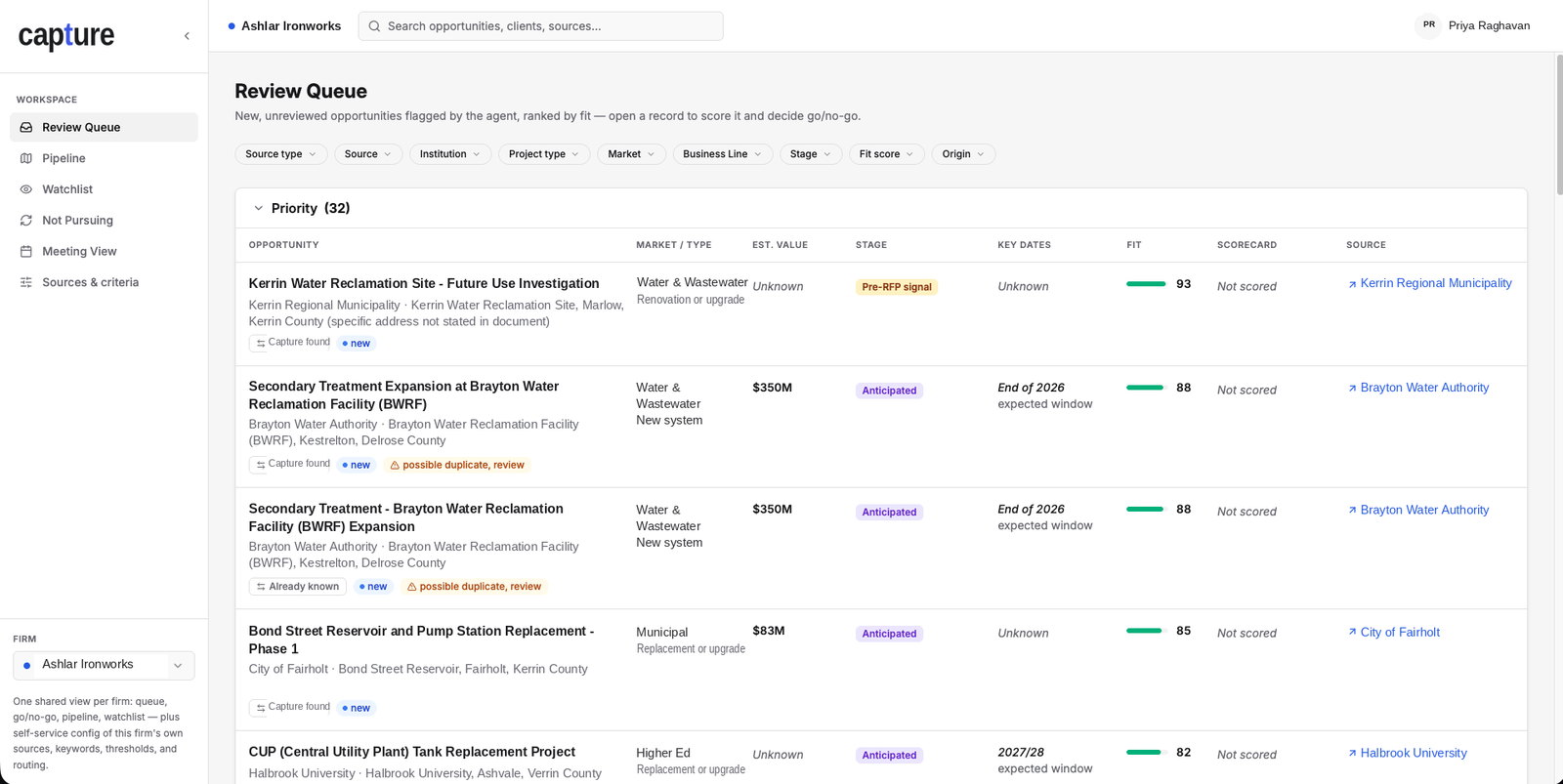
The Review Queue. New opportunities ranked by fit, each with its value, stage, key dates and source.
New opportunities arrive in one place, ranked by how well they fit this company. Priority holds the strong fits. A wider net holds everything else, visible rather than filtered away, because browsing what the system demoted is the fastest way to see what it is getting wrong.
Each record shows the platform's fit score, from 0 to 100, and the coordinator's own weighted scorecard. They are labelled as two different things on screen because they are. Every factor behind the fit score names its reason, links the document, and quotes the passage it came from.
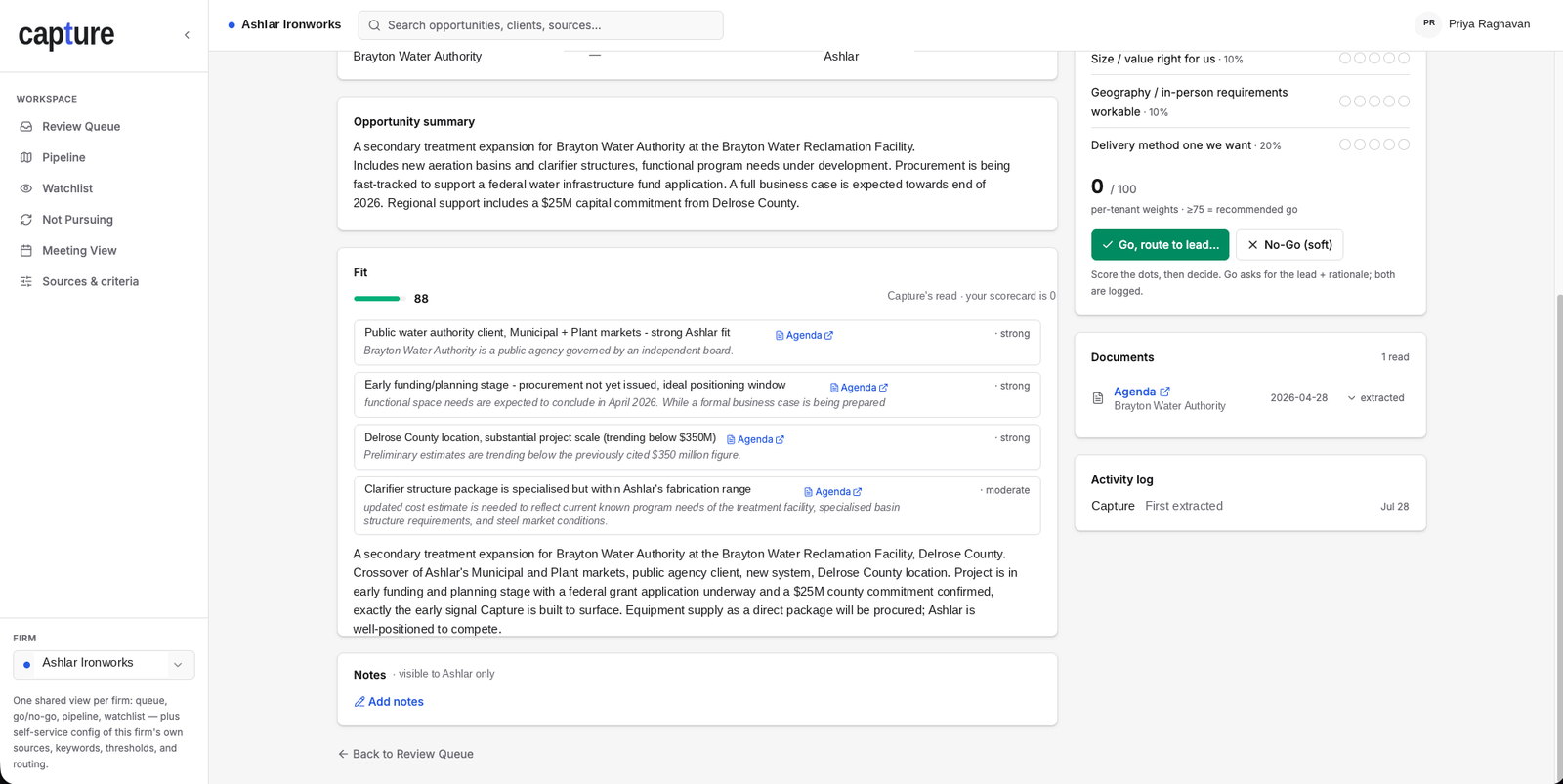
A fit score of 88, and the four factors behind it. Each one links the agenda it came from and quotes the line.
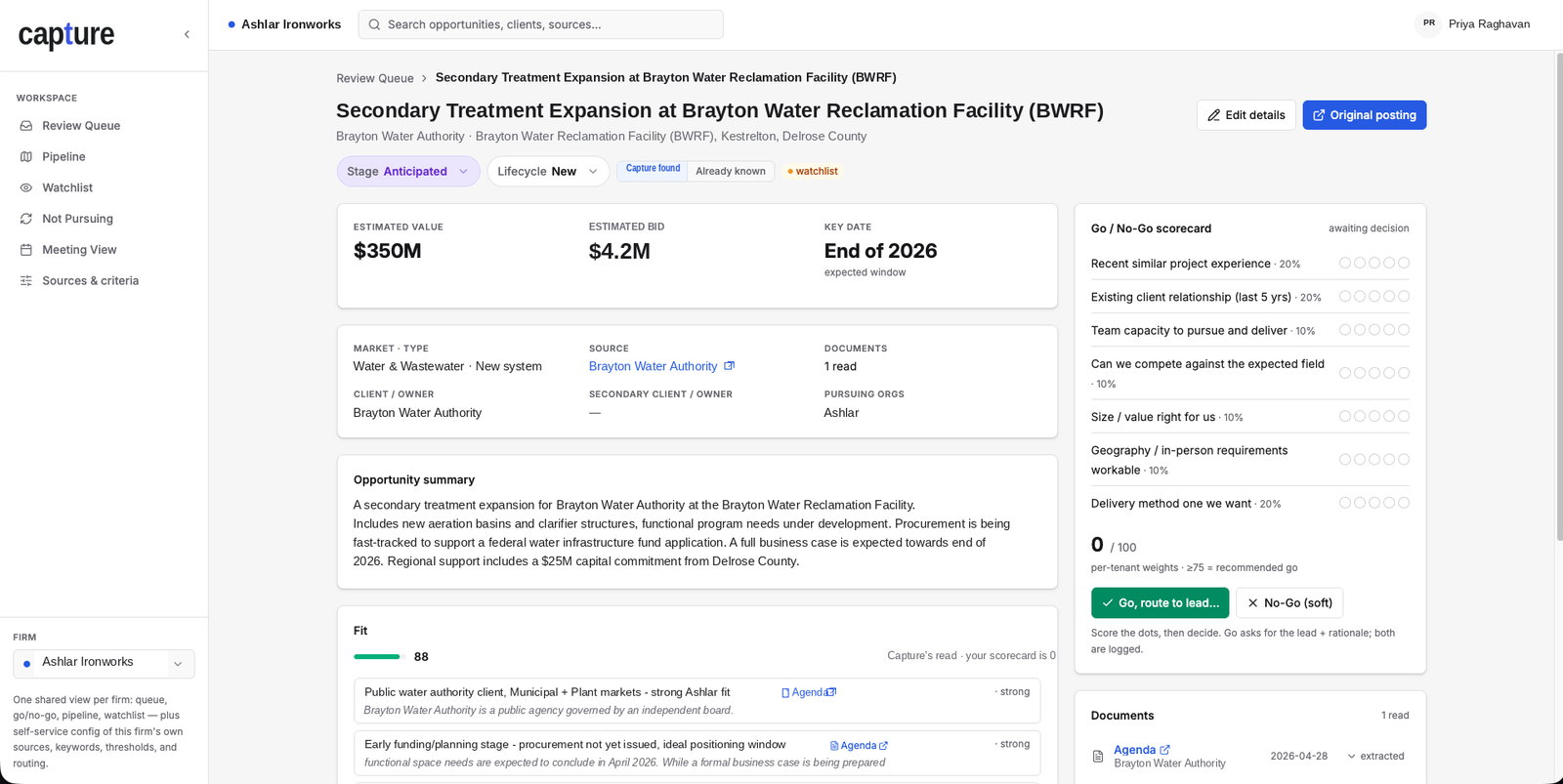
The go / no-go scorecard, on the record it belongs to. Seven weighted criteria, scored by the coordinator.
Seven weighted criteria, scored by the coordinator. A total of 75 or above shows as a recommended go. It is a recommendation, not a gate. A go asks who is leading the pursuit and why, and both are written down.
None of these is what the obvious build would have done. Each came from watching how the work actually runs.
Eight reasons to pass, each with its own rule for when the record comes back. A deferred project returns on any new sighting. Not our work never returns. Nothing that comes back arrives unexplained.
Public documents say what the whole project is worth. A manufacturer earns its equipment package inside that, not the total, so a $350M plant is not a $350M order. The person types what they would bid, and that amount is what is stored.
A made-up number that looks precise is worse than an honest blank. Where a document does not say, the field says so. And every value keeps the date it was published, because a figure from a two-year-old plan is a two-year-old figure.
Three companies went live within a week of each other. The first acceptance test cleared a bar that had been set before the test, not after it. In the first demo, the top of one company's queue was a project it was already scrambling to bid on; the software had read the first signal six months earlier. And a company president, in the first session he had ever seen the platform in, said he would stop maintaining the pipeline spreadsheet he had kept by hand for years.
Of the top 20 ranked opportunities were confirmed relevant by the company’s own coordinator
Against a bar of 70%, set before the test.
Public documents read so far, so that a person gets a shortlist
Council agendas, capital plans, board packets and bid portals.
From the first company going live to the third
Three launches, each after its own testing session.
In coordinator time, replaced by a $150 model bill
Across the three companies, in the first month live.
You cannot do this with a chatbot. The work is the queue, the score, the decision and the record behind it, and the people are still the ones deciding.
Nobody lost a job. The hours came back as better proposals and the pursuits worth the effort.