From first call to patient home safe.
A medical transport company coordinating patient logistics across borders, from initial intake through ground crews, aircraft, clinical teams, and final invoice, replaced a stack of spreadsheets and paper trails with one connected platform that holds every mission together.

Built with 5 AI agents
Get these agents- Request intake
- Quote creator
- Cross-system handoffs
- Three-way reconciliation
- KPI roll-up
When the process fails, a patient is stranded.
Critical case data lived in scattered documents and shared spreadsheets. Every coordinator kept their own conventions, their own colors, their own shorthand. When someone was on leave and a colleague had to step in, the file was nearly impossible to read.
Quoting was particularly fragile. A planned ground transfer becomes an air mission when a patient's condition changes mid-route. Quotes changed live, but nothing connected those changes to the books. Every closed mission ended in a multi-day reconciliation.
The setup worked for the current caseload. It would break at the next tier of growth. They brought us in to build the operating layer that holds the work together when it absolutely cannot fail.
We followed one mission. End to end.
We sat with the team across stakeholder interviews, demo cycles, pilot testing, and approval rounds. Picked one active mission and followed it from the first call through care destination, quoting, dispatch, clinical handoff, and finance close. Every system it touched, every form somebody filled twice, every place a detail could go missing.
That single mission became the blueprint. Once it moved cleanly through the new layer, the rest of the case types scaled out behind it.
Trace one mission, end to end
- Coordinator and clinical workflow shadow
- Quote-to-finance reconciliation audit
- Mission-record data model design
- Single-mission prototype across all systems
Build, roll out, pilot, polish
- Coordinator intake + care-destination workspace
- Live quote engine with version control
- Clinical roster with on-call escalation
- Finance integration + executive dashboards
Every mission, on one connected platform.
The platform follows a case from the first call through care destination, quoting, dispatch, clinical handoff, and finance close. Every coordinator works from the same record.
A care-placement workspace built for the way the team triages.
A coordinator's intake tool designed around how the team actually finds the right care destination. Every option logged side by side, real-time status visible to everyone, full search history preserved. Role-specific from the first request, not a generic database with a different label on top.
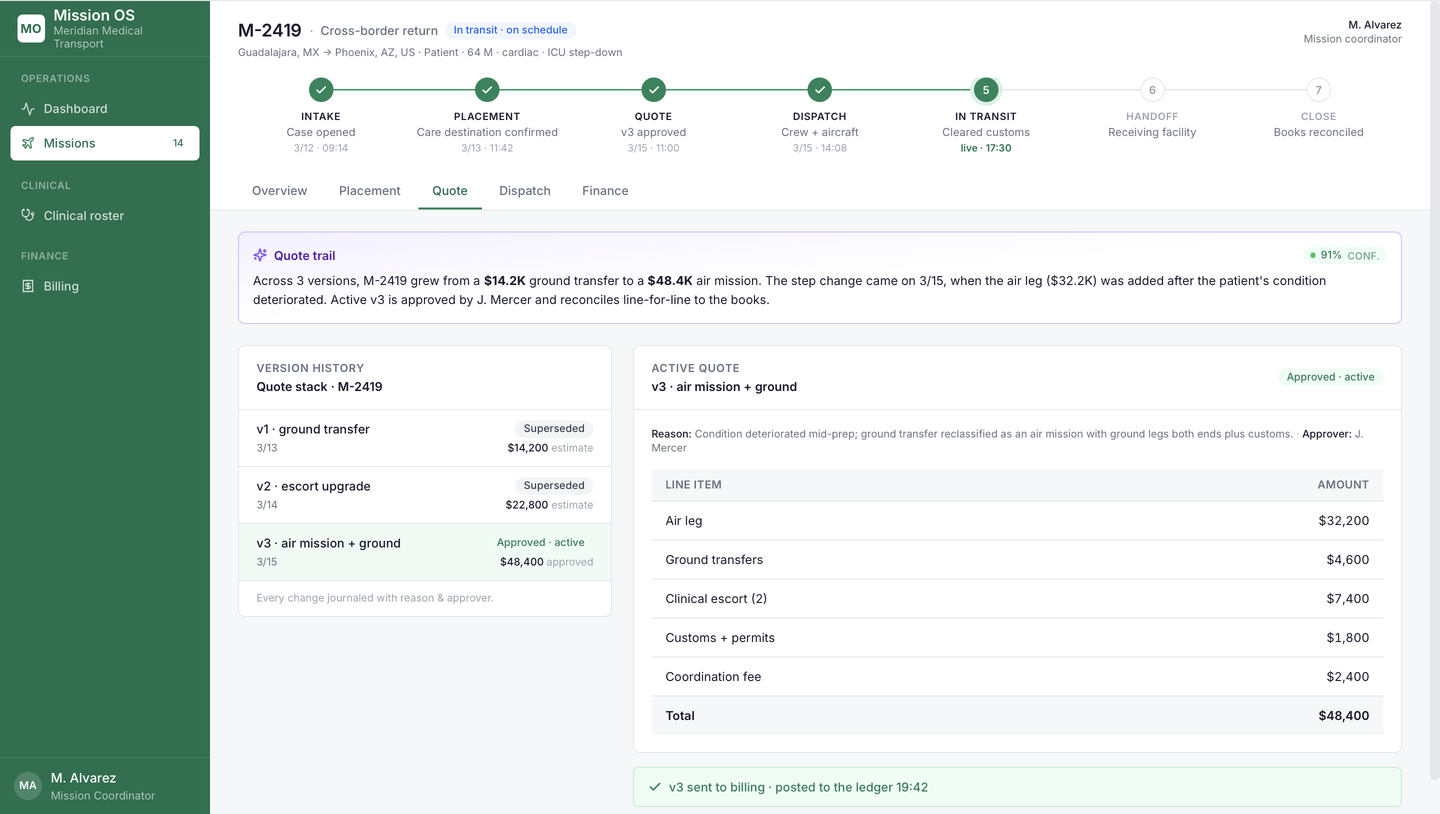
A quote engine for missions that don't sit still.
The most complex quoting we've built. A single mission generates multiple quote versions as conditions change on the ground or in the air, a ground transfer becomes an air mission, an escort gets upgraded, customs adds a leg. Every version is tracked, the active one connects directly to the books, and the financial picture is ready the moment the mission closes.
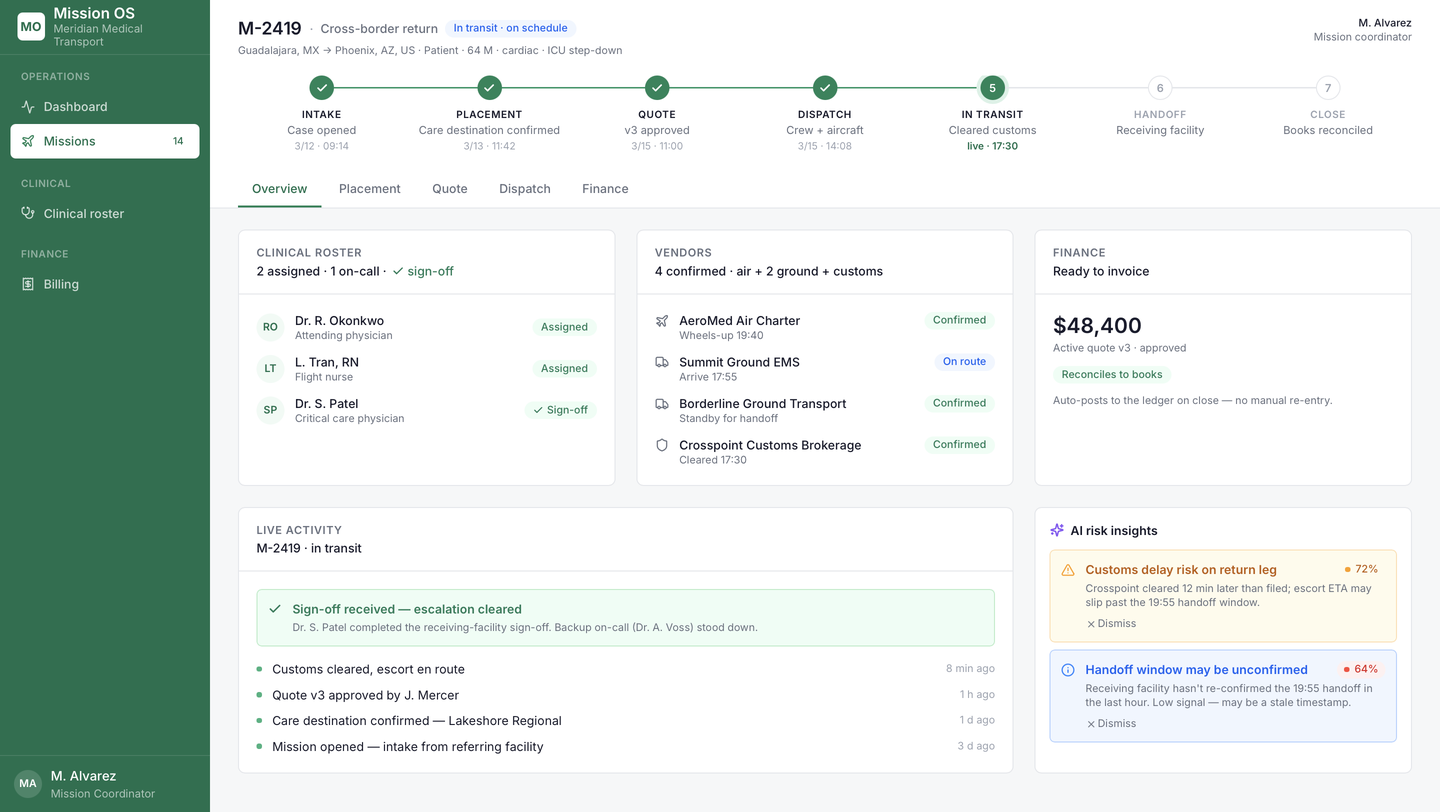
One workspace per mission, every team in it.
Coordinators, clinicians, vendors, finance, all working from the same record. Workspaces created automatically on launch. Clinical roster shows who's available, who's on call, and who needs to step in for sign-off, with built-in escalation if it isn't picked up. Closed missions flow straight to the books, no manual re-entry.
Critical work, running on one connected platform.
The team got their time back for the work that matters. Coordinators stop re-keying. Clinicians get the context they need faster. Finance closes missions cleanly. The team that saves lives spends more of their day saving them.
Less admin effort across mission ops.
Time back in case prep, staffing, and finance.
In avoided hiring as case volume kept growing.
Same team carrying meaningfully more work.
From mission close to invoice paid.
Down from a multi-day reconciliation per case.
Of every mission, end to end.
Coordinators, clinicians, and finance, in sync.