AI Agent vs Chatbot vs RPA vs Automation: One Invoice, Four Ways
A chatbot answers when asked, automation follows fixed rules, RPA clicks through screens, and an AI agent runs the whole job. One invoice shows the difference.
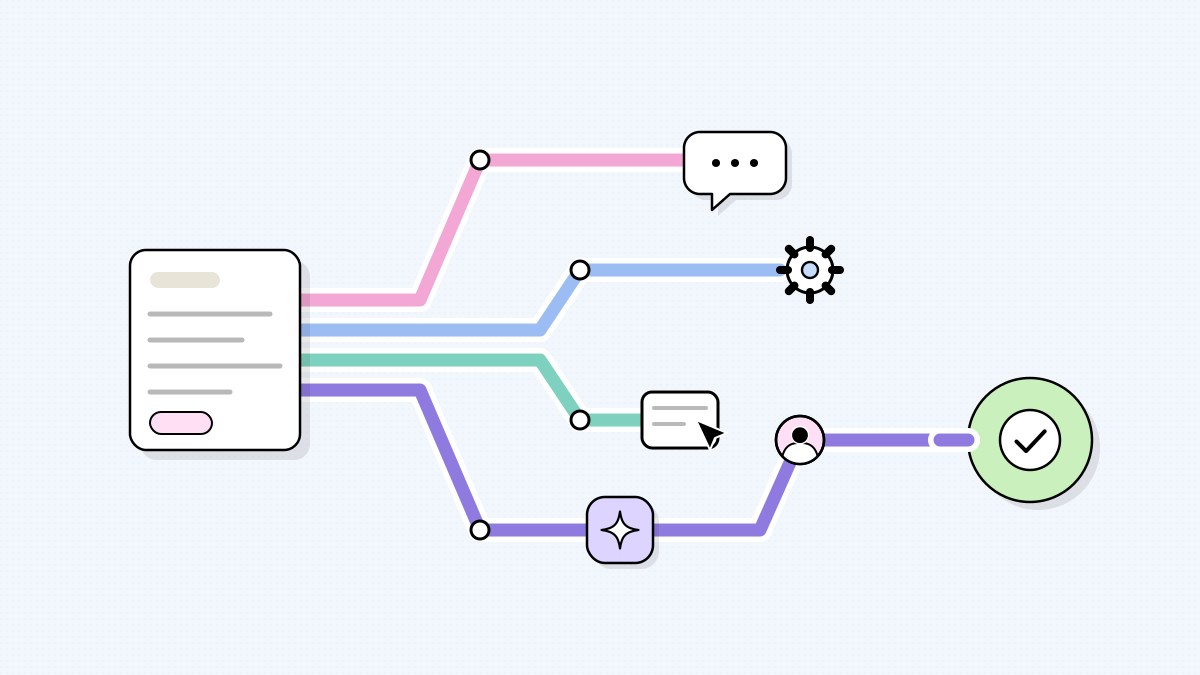
- A chatbot answers in a chat window when a person asks. Rules-based automation (Zapier, Make, Power Automate) moves data between systems on steps written in advance. RPA clicks and types through a screen the way a person would.
- An AI agent runs a whole recurring job, using AI for the steps that need judgment and automation for the rest, and hands the exceptions to a person. Most useful ones work from a review queue or inside your existing systems, not a chat window.
- One invoice, $212 over its PO, shows where each one stops. Chat stops when the conversation ends. Rules and RPA can’t read a messy scan or tell that two differently named parts are the same part. Our invoice matching agent does both and sends the $212 to the controller.
- Split the job first: rules for steps that never change, an agent for steps that need reading or judgment, and a person for decisions about money.
- For an AP team paying about 1,000 invoices a month, our workflow model puts invoice matching at about 162 hours a month back.
Thanksgiving, 1987.
Steve Martin, as Neal Page, needs to get from New York to Chicago.
Plane, train, bus, a rental car that catches fire, the back of a refrigerated truck.
No single vehicle got him home.
I think about Planes, Trains and Automobiles whenever someone asks me the difference between a chatbot, RPA, automation and an AI agent. I run a firm that builds AI agents for companies of 50 to 500 people, and the question usually assumes you have to pick one.
You rarely do. Follow one invoice and you’ll see why.
Meet INV-4471
Our passenger lands in the AP inbox as a scanned PDF: INV-4471 from Alder Supply, $6,412, billed against PO 2208, the purchase order you approved.
The vendor calls one item an “HD bracket, zinc”. Your PO calls it a “Mounting bracket 40mm”. Line 3 is $212 over the PO. Your tolerance, the most an invoice can run over before someone signs off, is $50, so this one needs the controller.
Home is a draft bill in accounting, ready for your team to release.
What is a chatbot?
A chatbot answers in a chat window and waits for a person to ask: the bot on your website, ChatGPT, Copilot. Paste INV-4471 and PO 2208 into a good assistant and ask if they match, and it will likely spot the $212 and work out that the two brackets are one part.
Then the conversation ends. Newer assistants can connect to other tools, but someone still has to start each conversation, and at 1,000 invoices a month, 999 more are waiting for someone to type.
Keep chat for a person thinking something through: a one-off question, a first draft.
What is rules-based automation?
Rules-based automation (Zapier, Make, Power Automate) moves data between systems when something happens, following if-this-then-that steps set up in advance.
The email arrives, so a rule saves the PDF, checks for a duplicate and pulls PO 2208 and the receiving log. Then it reaches the scan.
A rule can’t reliably read a scan when every vendor lays theirs out differently. And to a rule, “HD bracket, zinc” and “Mounting bracket 40mm” are two parts, so it never finds the $212.
If your invoices arrive clean and almost always match, a rule is the right answer, and the cheapest. Go set it up.
What is RPA?
Picture your AP clerk logging into accounting and typing the invoice into the bill form. Robotic process automation, or RPA, is software that does that job the same way, clicking, copying and typing through the same steps in the same order.
Move a button or change a layout and the rental car is on fire. It can’t tell the brackets match either, so the $212 slips past.
RPA makes sense when an old system’s only way in is its screen and the clicks never change. Most companies of 50 to 500 people I meet never bought any.
Their RPA is a person with two monitors, re-keying.
Most rules tools and the bigger RPA suites now offer an AI step that reads the page. Add one and you’re building a small agent yourself, and the questions become who owns the exceptions and who tests it.
What is an AI agent, and how is it different from automation?
Automation follows steps you wrote in advance and stops when the input doesn’t fit. An agent reads what arrives, decides within rules you set, and asks a person when it shouldn’t decide.
INV-4471, through our invoice matching agent:
- The AI reads every line off the scan. Automation checks for a duplicate.
- Automation pulls PO 2208 and the receipt, the log of what arrived.
- The AI matches line by line, knows the zinc bracket is the 40mm bracket, and finds line 3 is $212 over.
- Automation sees it’s past the $50 tolerance and asks the controller to approve the $212 or ask Alder for a corrected invoice.
- Automation saves a draft bill with the PO and match attached. The agent never releases a payment.
When we say agent, we mean all five steps. The AI only does the two a rule can’t.
If the scan is smudged, it doesn’t guess. Anything it can’t read clearly goes to a person. Before it goes live, we run it on your past invoices and check it against what your team did.
Nobody opened a chat window. Nearly every agent we build works from a review queue or inside your existing systems. If an “agent” is only ever a chat box, ask what happens when you close the tab.
For an AP team paying about 1,000 invoices a month, our workflow model puts that run at about 162 hours a month back. At a $45 loaded rate, that’s roughly $87,000 a year before running costs, which usually come to a small fraction of what the work costs by hand.
That time goes to vendor calls and cash planning. And when volume doubles, you don’t have to hire just to keep up.
About the word “agent”
Gartner calls it “agent washing”: rebranding assistants, RPA and chatbots as agents without real agent capabilities. In June 2025 it estimated only about 130 of the thousands of agentic AI vendors are real. That’s an estimate, and I sell agents, so weigh me accordingly. Its better line: “Many use cases positioned as agentic today don’t require agentic implementations.”
AI agent vs chatbot vs RPA: which one does your team need?
Chat for thinking something through, rules for clean data, RPA for a screen you can’t get around, and an agent for the messy recurring part, with a person owning the exceptions.
Home for Thanksgiving
Neal made it home, eventually. One of the vehicles was on fire.
Nobody at Alder Supply cares what INV-4471 rode in either. They just want to get paid.
PS, if your own INV-4471 is sitting in an inbox, this is what we build at Switchboard. Book an agent scoping call and we’ll tell you which stretches need an agent and which just need a rule.