How Much Does an AI Agent Cost? Ask for the Out-the-Door Price
A custom AI agent can run anywhere from $10K to $450K+, while a prebuilt one fitted to one job costs far less. Here are the seven costs behind the price.
- One development shop’s 2026 guide puts a custom-built AI agent anywhere from $10,000 to $450,000 or more, because the same word covers a help-page bot and a whole department.
- The build or fitting fee is one of seven costs, alongside connecting systems, testing on past work, AI usage, exception time, upkeep and optional support.
- AI usage runs about 18 cents an invoice at published token rates, a small fraction of what the same work costs by hand.
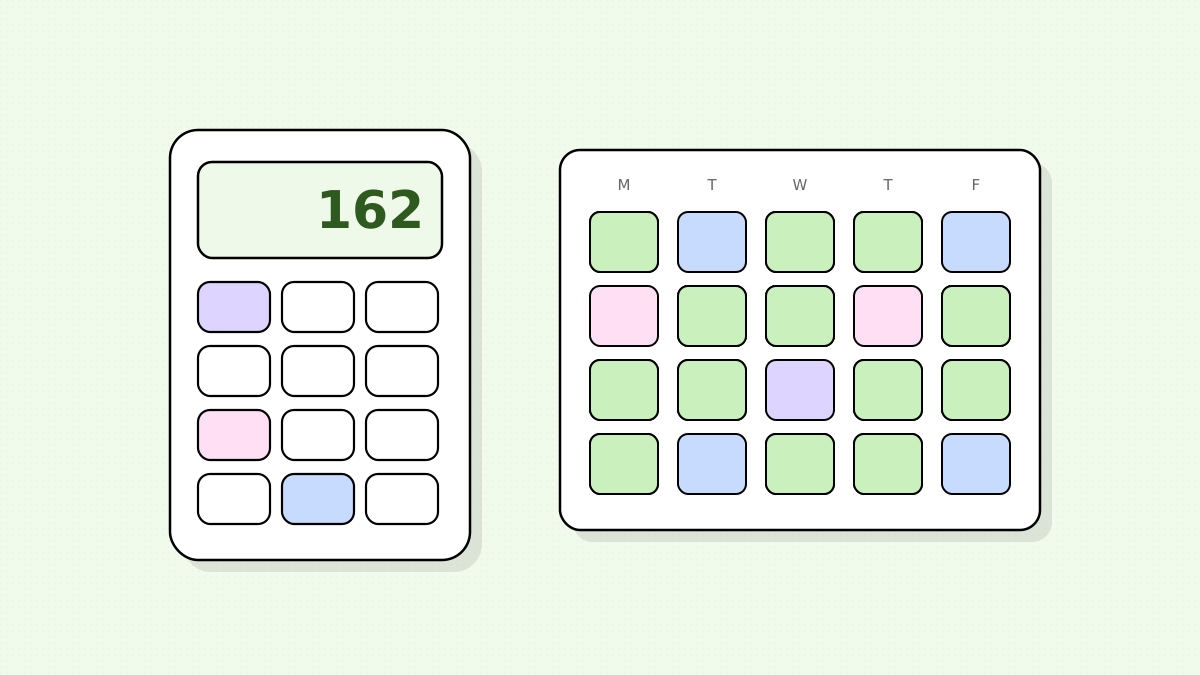
- Switchboard’s price is $12,500 fixed for one agent; at 1,000 invoices a month, invoice matching gives back about 162 hours of team time a month.
- Ask any vendor to price all seven lines in writing before they build; the fourth system and the upkeep owner are where quotes usually go quiet.
There’s a scene in Fargo I think about more than I should.
Jerry Lundegaard, car salesman, has a couple who agreed on a price. Then the paperwork shows up with TruCoat on it, a sealant they told him they didn’t want.
Jerry goes to “talk to his manager” and comes back with a slightly smaller number for it.
Buy one car and you learn the only number worth asking for is the out-the-door price.
Typing “how much does an AI agent cost” into Google puts you back on that lot. You get sticker prices in ranges wide enough to park a truck in, and almost nobody naming their own.
I run a firm that builds AI agents for companies of 50 to 500 people, so I have an obvious interest here.
Why are AI agent quotes so far apart?
An AI agent is software that takes one recurring job off your team’s desk. It reads what comes in, checks it against your systems and rules, does the work, and hands the odd case to a person.
One development shop’s 2026 guide puts building one at anywhere from $10K to $450K+. The same word covers a bot answering questions off a help page and a set of agents running a whole department. Shops quote hourly, on retainer, per task or as a fixed fee, and only a fixed fee names the build number up front.
Gartner sees the same thing at scale. In June 2025 it predicted over 40% of agentic AI projects will be canceled by the end of 2027, with “escalating costs” first among the reasons.
What goes into the cost of an AI agent?
Seven line items. Most of the ranges online only describe the first.
1. The build, or the fitting
The build is the biggest line on almost every AI agent quote, and the source of those wide ranges. From scratch, someone designs the steps, writes the code and learns to read a vendor’s blurry phone photo of an invoice, getting it wrong a few times while you pay for the lessons. A prebuilt agent skips most of that. You pay to fit it to your rules and to whoever signs off.
2. Connecting it to your systems
An invoice matching agent needs the AP inbox, the accounting system and the purchase orders (POs). Three doors. Every system it reads from or writes to adds cost, homegrown ones most of all. The fourth system, the one that exports a CSV when someone remembers to, is where the weeks go, so get it priced before anyone starts.
3. Testing it on your past work
Testing on your own history is the cheapest place to find out an agent can’t do your job. Run it on last quarter’s invoices, where you already know the right answers, before it touches this month’s, and ask who pays if it fails.
If a quote doesn’t include testing, the testing still happens. It just happens live, in front of your vendors.
4. The AI provider’s usage
Running an agent costs the AI provider’s usage plus hosting. Providers charge by the token, the small chunks of text a model reads and writes. As of September 2026, Anthropic lists Claude Sonnet 5.5 at $2 per million tokens in and $10 per million out. An invoice, its PO and its receipt, read a few times over as it checks each line, might come to 60,000 tokens in and 6,000 out: about 18 cents.
Find out whose account it runs on. Yours, at the provider’s rates, is the answer you want, and it lets you read their terms on whether your data trains their models.
Some products charge per use instead. Intercom lists its Fin support agent at $0.99 per outcome (as of September 2026), roughly a resolved conversation, so 1,000 a month is about $990. For a website support chatbot that’s often the right call. For a back-office job at volume, per-task pricing grows with every invoice.
5. The hours your people still spend
The controller still decides on the invoice that came in $212 over the PO, and that time belongs in the cost. During fitting, someone who does the job today gives it about an hour a week, then checks its work while it runs beside the team.
6. Upkeep when something underneath changes
Every AI agent needs someone to keep it current when a system or rule underneath it changes, like the approval limit moving from $5,000 to $10,000. The same guide puts maintenance at 15 to 30% of the build a year. On a fitted agent it’s mostly one named owner’s time, so pick them before launch and hand them the code and a runbook.
7. Optional support
With the code and accounts in your name, your owner can run it. Support is for when you’d rather someone else watched it every day. Ours starts from $1,000 a month.
Where our price lands
Switchboard Agents are $12,500 fixed for one agent and $30,000 for three, no license fees, live in 3 to 6 weeks. That covers lines one to three for up to three systems. A fourth is priced before we start. The pricing section lists what the $12,500 covers and assumes, billing included.
It lands there because our 80+ agents were built and tested on earlier client work.
What is an invoice matching agent worth at 1,000 invoices a month?
Take a team paying about 1,000 vendor invoices a month. Our model for the invoice matching agent gives back about 162 hours a month, across reading, matching and posting. At a loaded rate of $45 an hour (salary plus benefits and overhead), 162 hours is about $87,480 a year of team time, before anything comes off it.
Out the door, year one, is the $12,500 fee, about 18 cents an invoice in AI usage, and hosting and upkeep on your side. The controller’s time on exceptions is time they spend today anyway. Net of all that, the fee is usually covered in team time within 2 to 5 months, the payback range on our pricing.
Those hours only turn into cash if you’d otherwise have to hire. Count them as capacity: a calmer month-end, and 1,500 invoices a month next year without adding a seat in AP. At a client that doubled in size, HR went from six days to one between offer accepted and fully onboarded. Run your own numbers in the AI agent ROI calculator, or see the AI Agent Playbook work the sum for eighteen workflows.
Ask for the out-the-door price
Back to Jerry’s desk.
The couple didn’t mind the price. They minded finding TruCoat on the paperwork after shaking on it.
Before anyone builds you an agent, get all seven lines in writing, with a name next to each, then put them through these twelve questions.
Anyone who can’t fill them in is still selling you the TruCoat.
PS, if there’s a job you’d like off your team’s desk, the agent scoping call is 30 minutes. You leave knowing which agent fits and a payback estimate from your own numbers. Happy to chat.