AI Agent ROI: The Honest Payback Math (Free Calculator)
AI agent ROI takes four numbers: volume, minutes saved, loaded rate and running cost. At 1,000 invoices a month, invoice matching pays back in about two months.
- AI agent ROI comes from four numbers about one job: items a month, minutes saved per item, your loaded hourly rate (salary plus benefits) and the AI usage cost per item.
- Hours back a month is items × minutes saved ÷ 60. Payback is the fee (ours is $12,500 fixed for one agent; use whatever you’ve been quoted) divided by the monthly value of that time once running costs come off, counted from go-live.
- At 1,000 vendor invoices a month, 9.7 minutes saved each and a $45 loaded rate, invoice matching gives back about 162 hours a month, worth about $87,500 a year, against $2,160 a year in AI usage, so it pays back in about two months.
- Saved hours only become cash if you’d otherwise hire, so count them as capacity, and take off the time a person still spends on exceptions.
- If payback comes out above about two years, it’s probably not your first agent; pick a job with more volume or more minutes each time.
Office Space, 1999.
Initech has hired two consultants, both named Bob, to decide who keeps their job.
Tom Smykowski is up. His job, he explains, is getting the customer’s specs down to the engineers.
Except his secretary does that. Or they get faxed.
Bob Slydell asks, “What would you say you do here?”
That’s ROI math, with Tom as the line item.
I run a firm that builds AI agents for companies of 50 to 500 people, and a lot of the AI agent ROI math floating around is Bob math. Count the people, multiply by salaries, call whatever disappears the return. You get a big number and a nervous team, and the number is the first thing to go.
How do you calculate AI agent ROI?
You calculate AI agent ROI one job at a time: the team time the agent gives back in a year, minus what it costs to run, set against the fee to put it in. Four numbers from your own week get you there.
- Items a month. How many times the job lands on someone’s desk: vendor invoices, new hires, support tickets. Pull it from the system. Memory rounds up.
- Minutes saved per item. Time ten of them by hand this week, then take off what a person will still do once the agent has done its part.
- Your loaded hourly rate. Salary plus benefits, per hour. On average the Bureau of Labor Statistics puts benefits at 30% of what US private employers pay per hour worked (June 2026 figures), so divide the salary by 2,080 hours, then by 0.7. A $65,000 salary lands at about $45 an hour, and that’s a floor, before rent and software.
- Running cost per item. What the AI provider charges to read and write each one, at its published prices. For invoice matching that’s about 18 cents, and hosting adds a small monthly cost on top. The cost breakdown shows the working.
Hours back a month is items times minutes saved, divided by 60. A year of that time is worth the hours times 12 times your loaded rate. Running cost a year is items times 12 times the cost per item.
Payback is the number of months the difference takes to cover the fee (ours is $12,500 fixed for one agent; use whatever you’ve been quoted). Count from go-live, which for us is 3 to 6 weeks after kickoff.
Few teams do this sum before they buy. In an IBM survey of 2,000 CEOs from February to April 2025, only 25% of AI initiatives had delivered the ROI expected. It’s self-reported, but it matches my calls.
The calculator below does the sum for you. Pick one of our agents (67 of the 80+ in our catalog have one, taken from the same models as each agent’s page) and it fills in the minutes, the rate and the running cost. Then change the volume, the number of people who do the job, or any of our figures to match your team.
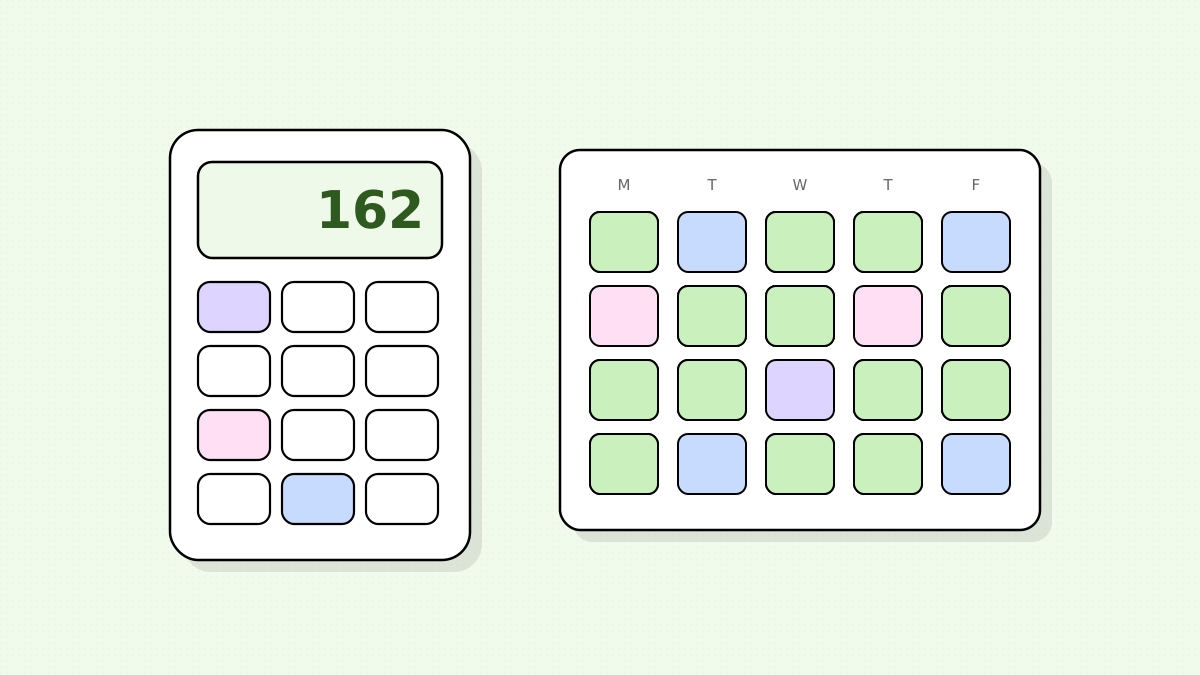
Worked example: 1,000 vendor invoices a month, about 9.7 minutes saved on each at a $45 loaded rate, is about 162 hours a month, worth about $87,500 a year of team time, against about $2,160 a year of AI usage. The $12,500 fee is covered in about two months.
What’s the ROI of an invoice matching agent?
Take a finance team paying about 1,000 vendor invoices a month. Our model for the invoice matching agent saves about 9.7 minutes on each, across the duplicate check, finding the purchase order (PO) and receipt, matching each line, readying what the controller needs and saving the bill for release. Their loaded rate is $45.
1,000 invoices at 9.7 minutes is about 162 hours a month.
Those hours, times 12, times $45, come to about $87,500 a year of team time.
AI usage costs 1,000 × 12 × 18 cents, or $2,160 a year.
That leaves about $85,300 a year, or $7,100 a month, so the fee is covered in about two months. Over a year, $85,300 less the $12,500 fee is $72,800, an ROI of about 580%.
The 9.7 doesn’t yet count the controller’s time on invoices that come in over the PO. Say one in ten takes them ten minutes: that’s 8.7 minutes an invoice, about 145 hours and $78,300 a year, and payback is still about two months.
That’s faster than the 2 to 5 months on our pricing because invoices come in volume. At 100 invoices a month the same agent gives back about 16 hours, and payback is about 18 months. Add our optional support, from $1,000 a month, and at 1,000 invoices payback barely moves. At 100, the support costs more each month than the time is worth, so it never pays back.
The sum also leaves out the hour a week one of your team spends with us while we fit it, and the upkeep when a rule changes. Treat the result as an estimate from your own numbers.
Do saved hours turn into real money?
Saved hours only turn into cash if you’d otherwise hire, or you’re paying overtime to keep up. Unless someone is leaving, the people stay and their week changes.
So count it as capacity. Month-end close stops eating the last three days of the month. When invoice volume grows next year, the same team takes it. Our HR client’s version was speed: after we automated their onboarding, offer accepted to fully onboarded took one day instead of six.
The $87,500 is a fair way to size the job. I wouldn’t book it as a saving in next year’s budget unless a hire comes off the plan.
Which jobs shouldn’t you count?
Rare jobs don’t belong in the sum. A reconciliation that eats a full day once a quarter feels enormous the day it lands. It’s 32 hours a year, about $1,440 at $45, and more than eight years to cover the fee.
Keep the judgment calls out of the minutes too. The controller still decides the invoice that came in $212 over the PO, with the paperwork in front of them.
If payback comes out past about two years, pick a different first job. At 50 invoices a month, invoice matching takes about three years; a job with more volume, or more minutes each time, will do better. Seven first agents, one per team, is where I’d start looking.
What would you say it does here?
Bob Slydell’s question works fine. Ask it of a job instead of a person, and the answer is a number you can check: how often the job lands, how long it takes, and what’s left for someone to decide.
So ask the invoices what they do here. They’ll answer in hours.
PS, if a job came out well in the calculator, bring the numbers to an agent scoping call. It’s 30 minutes, and we’ll check your minutes against how your team does the work today.